
The DSIG Standard provides a unified framework for collecting performance, game, and club data in sports.
It covers athlete performance metrics, game statistics, and club management information, ensuring compatibility with global systems for easier data sharing and analysis. As an open-source and free-to-use standard developed by DSIG, a non-profit initiative, it fosters accessibility and collaboration across the sports community.
By standardizing data collection, we unlock the potential for AI-powered insights that benefit the entire sports community while enabling the creation of an anonymized data pool of great value for all participants.
The 4 Core Rules of the DSIG Standard
Every dataset that claims to be DSIG-compliant must follow these four non-negotiable principles:
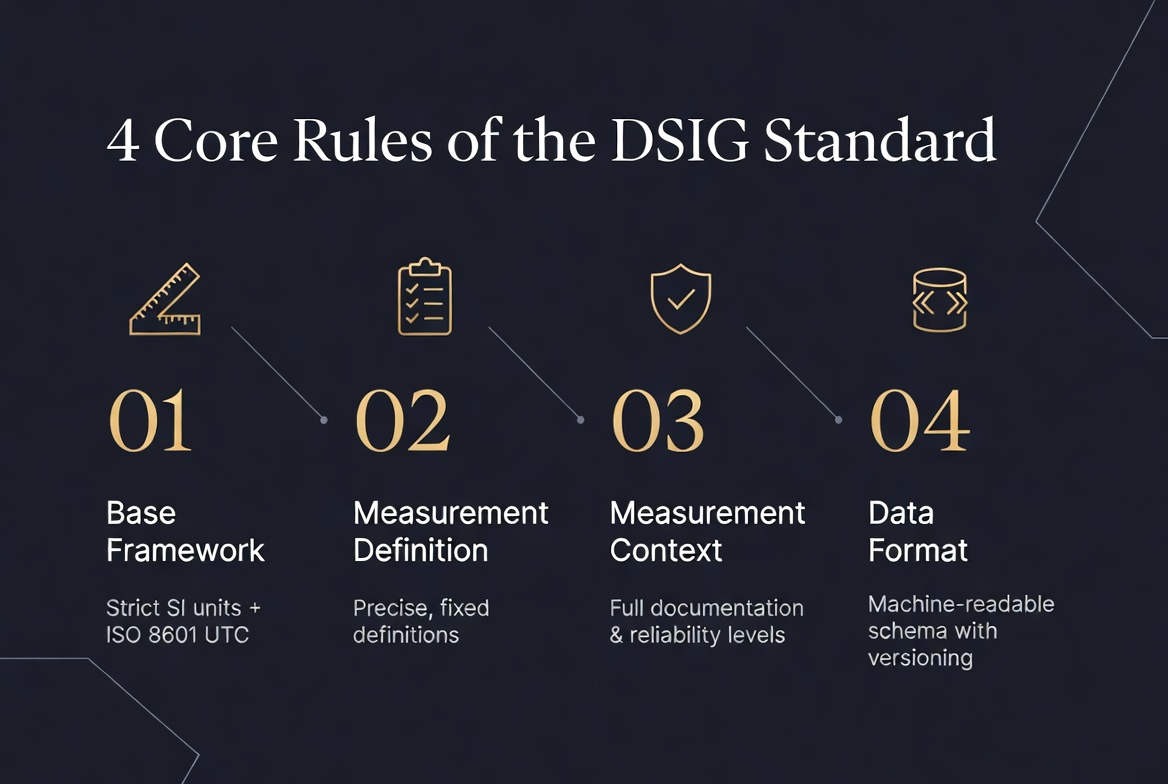
| 1. Base Framework | 2. Measurement Definition | 3. Measurement Context | 4. Data Format |
| All measurements use strict SI units (ISO 80000) and ISO 8601 timestamps in UTC. No exceptions, no conversions, no imperial units. | Every metric has a precise, unambiguous definition with fixed start and end conditions. Variants must be clearly labelled – reinterpretation is not allowed. | Full documentation of device specifications, environmental conditions, and reliability level (1–3) is mandatory. Any breach is automatically flagged as “limited comparability” | Data must be stored in a strict, machine-readable schema (JSON preferred). Mandatory fields, embedded versioning, and full backward compatibility are required |